Disabled parking in Atlanta starts with a state-issued placard or plate, and then runs into an Atlanta-specific rule most drivers do not expect. The State of Georgia gives you the credential, and the city decides where it works on the street.
This guide covers the whole path. First, how to get a Georgia disability placard or plate — the three colors, who qualifies, and what it costs. Then, where accessible spaces are in Atlanta, what the federal ADA requires of them, and the one meter rule that still applies even with a valid placard.
This guide serves residents applying for their first placard, individuals renewing an existing placard, and visitors arriving with a disability parking permit issued by another state. The rules are not always what people assume, and a few of them are easy to get wrong.
How Georgia’s disability placard and plate program works
Georgia’s disability parking credentials are issued by the Department of Revenue, not the Department of Driver Services. DDS states plainly that it does not hand out placards at its customer service centers; the DOR runs the program.
You apply at the county tag office in the county where you live, using Form MV-9D, the Disabled Person’s Parking Affidavit. A licensed doctor of medicine or osteopathic medicine, a podiatrist, an optometrist, or a chiropractor has to sign the form.
You do not have to own a vehicle to get a placard, and the placard moves with you into any vehicle you drive or ride in.
The same placard can also go to an institution — a group home, a shuttle service, or a care provider — when the primary use of the vehicle is transporting people with disabilities. Institutions apply at the county tag office where the organization is located.
The three colors: permanent, temporary, and special equipment
The color of the placard tells you what kind it is.
A permanent placard is blue. Authorities issue it free of charge and require holders to renew it every four years. A temporary placard is red. Authorities also issue it free of charge, and it remains valid for up to 180 days.
A special-equipment placard is gold. The driver receives it if their vehicle has hand controls to operate the brakes and accelerator or if they have lost the use of both upper extremities. The driver pays no fee, renews the placard every four years, and receives it in the same name as their permanent placard.
A permanent placard is for conditions that meet Georgia’s definition of a permanently disabled person. The Department of Revenue page lists them.
- Being hearing impaired to the point of not understanding normal conversational speech.
- A disability expected to incapacitate the person for more than 180 days.
- Being unable to walk 200 feet without stopping to rest, or unable to walk without a brace, cane, crutch, another person, a prosthetic device, a wheelchair, or other assistive device.
- Lung disease severe enough to require portable oxygen, or meeting the breathing-measurement thresholds the DOR lists.
- A cardiac condition classified as Class III or Class IV by the American Heart Association.
- Vision impairment where central acuity does not exceed 20/200 in the better eye, or a similarly limited visual field.
- Being severely limited in walking by an arthritic, neurological, or orthopedic condition, or by complications of pregnancy.
A temporary placard covers limitations from a surgery or an accident and lasts up to 180 days. If you need it longer, you apply again with a new certification.
The disabled license plate
You can also get a disabled person’s license plate instead of — or in addition to — a placard. A Georgia resident who owns or leases the vehicle, or their spouse, child, ward, or legal guardian, applies at the county tag office with the same Form MV-9D, or Form MV-9DB for a business.
The plate carries an annual $20 license plate fee, plus the usual taxes — Title Ad Valorem Tax, the annual motor vehicle ad valorem tax, or Georgia sales and use tax, whichever applies — an emissions inspection where required, and proof of insurance.
The plate is limited to a private passenger vehicle or motorcycle, a truck weighing 14,000 pounds or less, or a recreational vehicle used for personal transportation.
One difference worth noting is how the two credentials travel.
A placard follows the person, allowing them to use it in any vehicle they drive or ride in. A plate is registered to a specific vehicle, so it works better when the person with a disability regularly uses one car.
Where you can park in Atlanta
In Atlanta, accessible on-street parking is managed by ATLPlus, the city’s on-street parking operator.
Its parking zones page sets the rule for designated “Disabled Persons Parking Spaces”: a vehicle displaying a valid placard or license plate issued by the Georgia DMV — or an out-of-state or out-of-country equivalent — may park in those spaces.
Visitors are covered too. ATLPlus accepts a placard or plate issued by any other US state or country, so a valid out-of-state credential works in the city’s designated disabled spaces exactly like a Georgia one. That matters in a city with heavy visitor traffic.
That credential is the key that unlocks the space, and the federal side shapes the space itself.
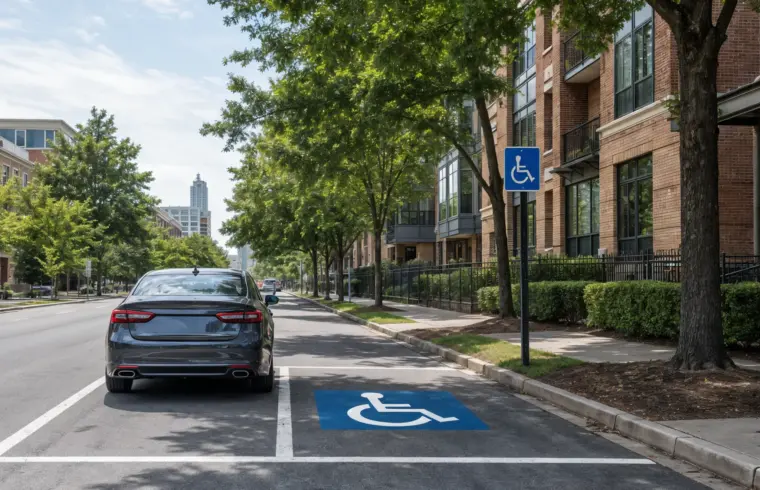
The Americans with Disabilities Act (ADA) requires authorities to mark accessible parking spaces with signs displaying the international symbol of accessibility and mount the signs at least 60 inches above the ground.
Van-accessible spaces must be at least 132 inches wide with an access aisle at least 60 inches wide and at least 98 inches of vertical clearance, on a slope no steeper than 1:48.
One useful way to think about it is the split between the street and the lot. The city’s on-street accessible spaces are ATLPlus’s to manage, while the ADA requires businesses, non-profits, and state and local government facilities to provide accessible spaces of their own in their lots and garages. So which rules apply depends on whose property you are on.
The Atlanta rule most people miss: payment is still required
Here is the part that surprises drivers from out of state. In Atlanta, a disability placard lets you use the accessible space, but it does not exempt you from paying.
ATLPlus clearly states that drivers must still pay to park in its designated disabled parking spaces. It does not exempt people with disabilities from the applicable parking rates.
This matters because it is different from many other cities, where a placard often waives the meter. In Atlanta you pay the same rate as everyone else at the space, so bring the same payment method you would use anywhere else in the city — the accessible space does not change the rate.
The broader meter calendar still applies, including the Sundays and city holidays that are exempt unless a sign says otherwise — see our Atlanta street parking meters guide for the zones and hours.
What to check before you rely on any of this
Placard rules, fees, and the meter policy change, and this article is a snapshot as of November 2026. The live pages are always the authority.
- The Georgia Department of Revenue disabled parking page for the current program and fees.
- Form MV-9D for the application itself.
- ATLPlus’s parking zones page for the current on-street accessible-space rule.
This article is not medical or legal advice. If you are applying for a placard, your doctor and your county tag office are the ones to follow, and the official pages above are the authority.
For the wider picture of parking in the city, see our City of Atlanta parking hub.