Paying at an Atlanta meter looks simple until the sign above the space turns out to be the part that matters. The City of Atlanta does not run one set of meter rules across the whole map. It runs zone types, each with its own enforcement window and its own time limit, and the difference between a legal hour and a citation can come down to which block you parked on.
The good news is that none of this is guesswork. The Public Parking Management Program, the partnership between the City’s Department of Transportation and ATLPlus that installs, maintains and enforces the meters, publishes the rates, the hours and the citation schedule. As of September 2026, this is how Atlanta’s metered on-street parking works.
Here is the short version.
- Most Atlanta parking meters charge $3.50 per hour, and the posted placard at the space is the final word.
- Meters are pay-by-plate: you enter your license plate number at the pay station and never put a receipt on your dashboard.
- Enforcement runs Monday through Saturday, but the hours and the time limit depend on the zone type.
- Sundays and City holidays are exempt, and no meter payment is required on those days.
- An overtime meter citation is $35.00, rising to $70.00 after 14 days and $95.00 after 45 days.
What Atlanta’s parking meters cost
ATLPlus publishes the current rate plainly: most parking meters are $3.50 per hour. That is the number to plan around, and it is also the number to check rather than assume.
Atlanta’s parking zones are marked by signs and by meter decals or rate placards. The city’s own guidance is to read the signage and the placard at the time you park, because the restriction attached to a space is the one that governs it.
Two boundaries are worth naming. A metered space is a paid, time-limited space on a city street. A residential permit district is a different program with its own rules, and parking in one without a valid permit has nothing to do with whether you fed a meter.
How pay-by-plate works, and what you can pay with
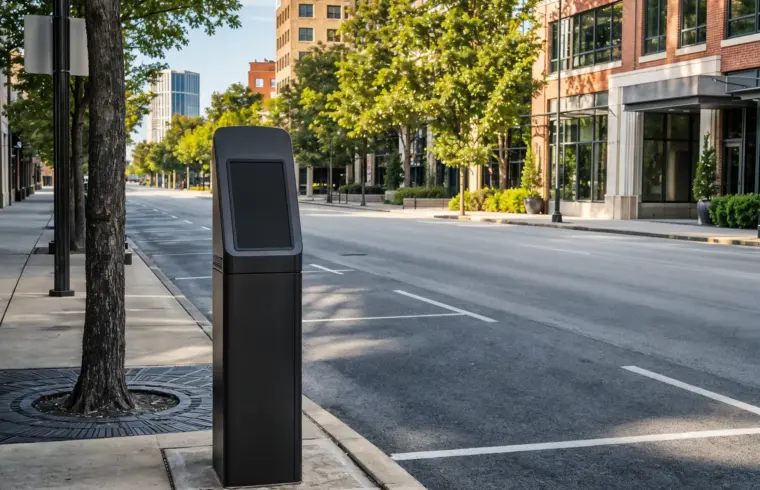
Atlanta’s pay stations are solar powered, and they work by license plate rather than by paper receipt. You park, walk to the nearest pay station, enter your plate number, choose the amount of time you need, and pay. That is the whole transaction.
The city’s advice is to remember your plate number before you walk away from the car, and it suggests taking a picture of it with your phone. That habit removes the most common reason people stall at the machine.
The plate number is what links your payment to your space, so the receipt is for your records rather than your windshield. Atlanta has worked this way since pay-by-plate arrived in the summer of 2017, and there is no display requirement at all.
If your time is running short, you can buy more of it remotely through a smartphone app instead of walking back to the station.
Every pay station and meter accepts coins and credit or debit cards, and the accepted card brands are Visa, Master Card, Amex and Discover. Cash is the exception rather than the rule: not all of them take cash, and those that do are the locations with historically high cash use. Where cash is accepted, it is United States currency in single one-dollar bills or coins.
Phone payment is available as well: text-to-pay, or any of the apps listed at parkingapp.com. The city does not issue refunds on pay station, meter or app transactions, so buy the time you actually expect to need.
If a station turns out to be broken, the published procedure is to walk to another station, pay by text or app, and call 404-201-5396 to report the malfunction.
Enforcement hours depend on the zone type
This is where Atlanta rewards the driver who reads the sign. ATLPlus groups metered and time-limited parking into zone types, and each type carries both an enforcement window and a maximum stay.
Business and government zones are enforced Monday through Saturday, 7 AM to 10 PM, with a two-hour limit. Mixed-use zones run Monday through Saturday, 8 AM to 6 PM, with a three-hour limit.
School and university zones are enforced Monday through Saturday, 7 AM to 10 PM, with a three-hour limit. Entertainment, restaurant and hospital zones follow the same 7 AM to 10 PM window with a four-hour limit.
The posted time-limit signs work differently from the zone types. The 30-minute, one-hour, two-hour, three-hour and four-hour zones are in effect Monday through Saturday, 24 hours per day. An evening park in one of those spaces is still a timed park, even when it falls outside the window governing the business zone next door.
All parking meter zones are governed by City ordinance, and the city’s instruction is to check the local signage and the meter placard at the time of parking. A zone page tells you the type. The sign at the curb tells you the rule attached to that particular space, and the posted sign is the one to trust.
Sundays and City holidays are exempt
Atlanta gives meters a weekly day off. No metered on-street parking enforcement occurs on Sundays, and none occurs on City holidays. No payment to meters is required on those days.
The city lists its exempt holidays as New Year’s Day, Martin Luther King Jr. Day, Memorial Day, Juneteenth, July 4th, Labor Day, Veterans Day, Thanksgiving Day and the day after, and Christmas Day.
The exemption is still worth a glance at the curb. Sundays and City holidays are exempt unless otherwise posted, so a space can carry its own restriction on a day the rest of the city is off the clock.
Time limits, overtime citations, and what they escalate to
Atlanta sets time limits to keep spaces turning over for the businesses around them, and some areas require your vehicle to leave when the maximum time for that area is reached. Feeding the meter for a longer stay is not always an option.
Staying past what you paid for is a parking meter violation under City Code section 150-133, and the penalty escalates on a published schedule. The citation is $35.00 within 14 days. It rises to $70.00 if it is unpaid after 14 days, and to $95.00 after 45 days.
The city’s non-meter violations cost more. Parking on a crosswalk or bridge, or blocking a public or private driveway, carries $75.00 within 14 days and $150.00 after that. The same fines apply within 20 feet of a crosswalk, 15 feet of a fire hydrant or 30 feet of a stop sign.
Parking in passenger or freight loading zones, bus stops or taxi stands also carries $75.00 within 14 days and $150.00 after 14 days.
Ignoring citations carries a second cost beyond the fine. A vehicle can be immobilized once it has been issued at least three unsatisfied delinquent tickets, and the charge for removing the device is capped at $50.00 per day.
If the vehicle is immobilized and the associated tickets, fees and fines are not paid in full within 24 hours, it can be removed to a vehicle pound or other place of safety.
Parking is also prohibited between 1:00 a.m. and 6:00 a.m. on any street inside the central district. That area is bounded by Baker Street to the north, Ivy Street and Central Avenue to the east, Mitchell Street to the south and Spring Street to the west.
A citation is not the end of the process. The city’s published options after a parking violation are to pay the citation or to appeal it, and photo documentation is viewable through the appeal route.
Loading zones, accessible spaces, and what to do if something goes wrong
A few on-street spaces carry rules that are not about the meter at all. Passenger loading zones allow a vehicle to stop strictly for the purpose of loading or unloading passengers.
Commercial loading zones, marked with an orange curb, are for trucks and commercial vehicles holding a special permit from the Office of Transportation. They are in effect from 6:00 AM to 6:00 PM.
Disabled persons parking spaces require a valid placard or license plate issued by the Georgia DMV, or an out-of-state or out-of-country equivalent. Payment is still required. The city states plainly that people with disabilities are not exempt from the prevailing parking rate.
If your car is towed, call A-Tow at 404-577-6566. Towing, impound and storage payments are made in person at A Tow Atlanta, 180 Harriet Street, Atlanta, GA 30315, which is open 24 hours a day, seven days a week. Bring valid registration and insurance information for the vehicle’s release.
For everything else, ATLPlus customer service is 404-201-5396, with representatives available 8 AM to 5 PM Monday through Friday Eastern Time excluding City holidays. Automated payment services are available around the clock. Comments or concerns about the program go to the Parking Program Office at 404-330-6501.
What to check before you rely on any of this
Meter rates, zone hours and citation amounts are set by the City, published by ATLPlus, and can change. The rate in this article is the one ATLPlus published as of September 2026, and the placard at the space you take is always the authority for that space.
- The parking zones page for the enforcement hours and time limits by zone type.
- The FAQ page for the current hourly rate, payment options, and how to report a broken meter.
- The citations page for the current fine schedule, and the appeal route if you want to contest a citation.
Rules and rates are published by the City of Atlanta and ATLPlus, not by this site. Where ATLPlus’s page and anything here disagree, ATLPlus’s page controls, and current City information always supersedes this article.
If you are looking at Atlanta’s residential streets instead of its meters, see our Atlanta residential permit parking guide. For park-and-ride instead of on-street parking, see the MARTA station parking guide.
The wider picture for Atlanta parking lives in our City of Atlanta parking hub.