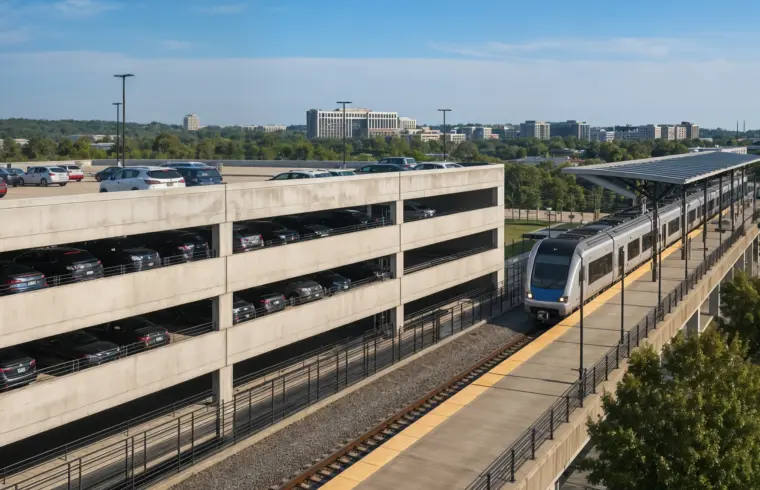
If you drive to a MARTA rail station to catch a train, parking is the part nobody plans for until the lot is full. MARTA runs one of the largest transit parking networks in the country, and the rules are specific: parking is free only inside a 14-hour window, and staying past that window is where the money starts.
As of September 2026, this is how it works. Most MARTA stations that offer parking are free daily lots with a 14-hour limit. A smaller set of nine stations also run secured long-term parking for multi-day trips, at either $7 or $10 per day.
This guide covers which stations have free daily parking, what long-term parking costs, how payment works, and how to check whether a lot is full before you leave the house.
Here is the short version.
- Daily parking is free for up to 14 hours at the 23 rail stations that offer daily parking.
- Long-term parking after 14 hours costs $7 or $10 per day at nine stations.
- Pay at an on-foot kiosk with a card or cash before you exit. MARTA does not take checks.
- All MARTA parking decks and lots are open 24 hours.
- MARTA publishes a live lot-status board in green, yellow, and red so you can check capacity first.
Free for the first 14 hours
MARTA states the rule plainly on its parking fees page: if you park in one of its daily lots or long-term lots for less than 14 hours, there is no charge. A ticket dispenser gives you a ticket when you enter, you keep it with you, and on the way out you present it at the exit machine. Park under 14 hours and you pay nothing.
That 14-hour window is the number to remember. A normal commute and a full workday fit inside it, but an overnight stay does not. Anything past 14 hours moves you into long-term territory, and the meter starts.
The window applies the same way whether the space is in a free daily lot or a paid long-term deck. The distinction is not the first 14 hours, which are free in both, but what happens after.
Which stations have free daily parking
MARTA reports that free daily parking is available at 23 of its rail stations. Here they are, listed by rail line as MARTA publishes them.
- Red line: North Springs, Sandy Springs, Dunwoody, Medical Center, Lindbergh Center, West End, Oakland City, Lakewood/Ft. McPherson, East Point, and College Park.
- Gold line: Doraville, Chamblee, Brookhaven/Oglethorpe University, and Lenox.
- Blue line: Hamilton E. Holmes, West Lake, Inman Park/Reynoldstown, Edgewood/Candler Park, East Lake, Avondale, Kensington, and Indian Creek.
The in-town stations are the opposite story. Five Points, Midtown, North Avenue, Civic Center, Peachtree Center, Georgia State, King Memorial, and the Airport station generally have no parking at all, because those stations are built to be reached on foot or by connecting transit rather than by car.
The free-daily pattern is easy to read. Free parking sits at the park-and-ride stations at the ends of the lines — North Springs and Doraville in the north, College Park in the south, Indian Creek in the east, and Hamilton E. Holmes in the west — while the in-town stations have none.
Two station notes are worth knowing before you commit. North Springs has two parking decks, and MARTA says you must exit the same way you came in. Lindbergh Center’s parking is located behind MARTA Headquarters, off Sidney Marcus Boulevard.
Long-term parking: the nine paid stations
If you need to leave a car at a station for more than 14 hours, MARTA offers long-term parking at nine stations. The rate depends on the station, and MARTA divides them into two price groups.
- $7 per day: Dunwoody, Medical Center, Kensington, Lenox, and Sandy Springs.
- $10 per day: College Park, Doraville, Lindbergh Center, and North Springs.
MARTA calls these long-term secured spaces and charges by the day after the first 14 free hours. It also charges for partial days, so a 15-hour stay and a 24-hour stay are not the same bill.
This is the arrangement that makes a multi-day trip work. If your trip is measured in days, the long-term stations are the option. If it is a single workday, the free daily window is enough.
How payment works
MARTA finished upgrading the payment equipment at those nine long-term stations in April 2025, replacing older systems with pay-on-foot kiosks. The flow is simple: take a ticket on entry, keep it with you, then pay at a kiosk on foot before you leave, with cash or a card.
Payment options are specific. MARTA accepts Visa, MasterCard, Discover, and American Express, plus cash at the pay-on-foot machines. It does not take checks. The full rate and payment list lives on MARTA’s parking fees page.
The practical point is to pay before you walk back to your car. The kiosks are positioned so you settle up on foot, then drive out.
The lot-full problem and how to check before you go
The single most common MARTA parking complaint is arriving at a busy park-and-ride station and finding the lot already full. MARTA publishes a live station parking status page that shows each station’s lot in one of three colors.
- Green: the lot is open.
- Yellow: the lot is open, but between 51% and 75% of capacity.
- Red: the lot is full.
The statuses are monitored by on-site MARTA staff at the listed stations. That live status page is the thing to check before you leave, because free parking does not help if the lot is full by 7:30 AM.
MARTA station parking and the airport trip
For a flight out of Hartsfield-Jackson, parking at a MARTA station and riding the train in is a common alternative to the airport’s own decks. The MARTA side of that decision is the long-term rate at a station like College Park, Doraville, or North Springs, plus the train ride itself.
College Park is the long-term station closest to the airport, and its $10 daily rate plus the short ride in is the pattern most airport park-and-riders follow.
What this article does not quote is airport parking rates. Those are published by the airport, not by MARTA, and they belong on the airport’s own pages. To compare, you need both numbers: MARTA’s $7 or $10 per day plus the fare, against whatever the airport decks charge.
For a day trip, remember the 14-hour free window applies to your MARTA parking too, so a single workday at the station costs nothing.
What to check before you rely on any of this
MARTA’s parking rules change, and the rates and the free window can move again. Before you rely on a specific station’s free-daily or long-term status, check MARTA’s current pages.
- The parking fees page for the free-window rule, long-term rates, and payment options.
- The parking availability page for the station-by-station chart.
- The live lot status page for green, yellow, or red before you drive.
For questions, MARTA’s Parking Command Center is at 404-848-4064 or automatedparking@itsmarta.com.
If you are parking on Atlanta’s city streets rather than at a MARTA station, the rules are different.
See our Atlanta residential permit parking guide for the street-parking side of things, and the City of Atlanta parking info hub for the wider picture.
Rules and rates are published by MARTA, not by this site. Where MARTA’s page and anything here disagree, MARTA’s page controls, and current MARTA information always supersedes this article.