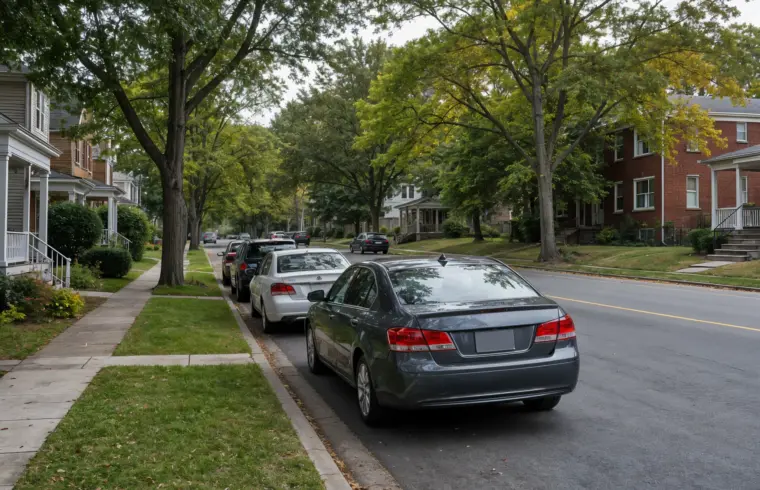
If you live on a street inside one of Atlanta’s residential permit districts, the curb in front of your building is not first-come, first-served. Inside those districts the city allows parking on the public right of way only with a valid, non-expired permit, and it enforces the rule by reading license plates.
The City of Atlanta runs this through its Department of Transportation as an online permitting program. The annual permit fee the city publishes is $20.00. What catches people out is not the fee. It is not knowing whether their block is covered at all, and a small license plate detail that the city says can produce erroneous citations.
This guide covers what the program is, which Atlanta neighborhoods participate, what a permit costs, how to apply, and what to check before you rely on any of it. It also covers the license plate detail the city publishes, and where the city program’s scope ends and other parking arrangements begin.
The short version, if you only read one part:
- Districts are permit-only; the city allows parking on the public right of way inside one only with a valid, non-expired permit.
- One annual residential permit costs $20.00.
- Applications and documents go through the city’s online permit portal.
- Enter zeros, not the letter “O”, for every plate you register.
- Enforcement is ATLPlus; the permit program is ATLDOT’s.
What the residential permit program actually is
The program is the ePermitting Restricted Parking Permit (RPP) Program, administered by the City of Atlanta Department of Transportation (ATLDOT).
ATLDOT describes its purpose as easing parking congestion “in residential neighborhoods around significant demand generators, while balancing the needs of all people to be able to use the public streets” — in other words, it exists where a neighborhood’s curbs are under pressure from people who are not residents.
The mechanics are simple and strict. Inside a designated neighborhood parking district, parking on the public right of way is allowed only with a valid, non-expired permit. The participating districts and the program guidelines are set out in ATLDOT’s own parking services material, which cites City Code 21-O-0474 as the governing authority.
Two consequences are worth stating plainly:
- A permit is a permit, not a reserved space. The program restricts who may use the curb, not which part of it is yours.
- It is enforced by plate, not by sticker or hangtag. That is where the plate detail later in this guide matters.
Which Atlanta neighborhoods have permit districts
ATLDOT lists the neighborhoods currently participating in the program:
- Ansley Park
- Ardmore
- Atkins
- Brookwood Hills
- Buckhead Forest
- Castleberry Hill
- Glen Iris
- Home Park
- Inman Park
- Inwood Circle
- Midtown
- Peachtree Park
- Poncey-Highland
- Forrest St. NW
- Vine City
- Virginia Highland
One note on Midtown: the city states that Midtown residential permits now include the former Myrtle Street permits.
The operative word is “currently”. District lists are administrative and they change as the city adds or adjusts coverage, so the list above is a starting point for checking your own street, not a substitute for checking it.
Districts are administrative and coverage can change, so being in a listed neighborhood does not necessarily establish that a particular curb location is covered. Verify your street against ATLDOT’s current district information, and follow the city’s permit application process for the current requirements.
What a permit costs and how to apply
The annual fee is $20.00 per permit. ATLDOT states that an annual Residential Parking Permit may be purchased at that price, and that the Residential Permit Application is due with the submittal of the online application.
Applications are handled online. The city moved its permitting onto online application software so that applicants can submit parking applications, upload required documents, pay permit invoices, and receive their permits online, and the residential application link on ATLDOT’s parking services page leads to the city’s permit portal.
Practical sequence, from the city’s own material:
- Verify that your street is covered, using ATLDOT’s current district information and the city’s permit application process.
- Complete the online Residential Permit Application and pay the invoice through the portal.
- Upload the required documents with the application — the city requires documentation as part of the submittal.
- Enter the plate numbers the city’s application asks for, accurately (see below).
Questions about the permit process go to the Department of Transportation Permit Department at 404.330.6501.
The plate detail the city warns about
This is the single most useful thing on this page.
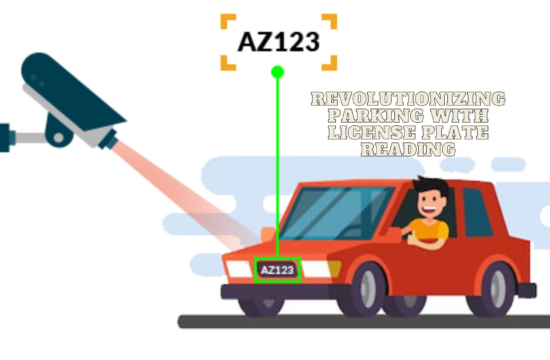
The system the city uses to enforce residential parking is license plate recognition (LPR). ATLDOT warns that the LPR system does not recognize the letter “O” in plate numbers entered for parking applications.
The instruction is to enter a zero instead. ATLDOT’s own example: a plate reading “H O RIZ O N” should be entered as “H 0 RIZ 0 N”. The city’s stated reason is that this will eliminate potential erroneous citations issued to residents and their guests.
The city links plate accuracy directly to avoiding citations for residents and guests — and adds that double-checking each plate number can also help avoid citations. That is why the plate-entry step is worth as much attention as the fee.
Other parking permits the city issues
Residential permits sit alongside several other city parking permits, and ATLDOT handles them through the same online system. The permit types ATLDOT lists include Commercial Vehicle Parking, On-Street Valet Parking, Park for Hire, and Temporary Parking Lot permits.
Valet parking is a useful illustration of how the city treats permits generally: a business that wants to operate a valet service on city streets must obtain a Valet Parking permit, permits are good for one year and must be renewed annually, and operators have to meet all safety standards and provide documentation.
ATLDOT’s parking responsibilities extend beyond permits to the metered on-street parking system, residential and valet permit parking, commercial loading and unloading, and permitting of public parking lots and garages.
The permit types themselves — Commercial Vehicle Parking, On-Street Valet Parking, Park for Hire and Temporary Parking Lot — are listed on ATLDOT’s parking permits page.
If your question is about the parking system rather than a permit, the City of Atlanta Parking Info hub is the place to start, and ATL311 takes service requests.
Where the program’s scope ends
The residential permit program described here applies to qualifying public right-of-way parking: the city’s districts allow on-street parking on public right of way only with a valid, non-expired permit. Parking in private lots, garages, or building-managed spaces is governed separately by the applicable owner, operator, or property rules.
That distinction is worth having clear when you are working out which set of rules applies to a particular space:
- Public right of way inside a permit district. The city’s rules apply, and its plate-based enforcement applies with them.
- Private lots, decks, and building-managed spaces. These are governed separately, by the owner, operator, or property rules that apply there.
- Reserved or allocated spaces. Whether a space is deeded, leased, or allocated is a matter for the parties involved rather than a question about the city’s residential permit program.
A residential permit is therefore about standing on the public street inside a district. It is not a space in a private facility, and it does not replace a building’s own arrangements.
If you are a guest, a visitor, or a short-term renter
Because enforcement relies on license plate information, residents should make sure any plate information the city’s permit process requires is entered accurately.
ATLDOT specifically warns that its LPR system does not recognize the letter “O” and instructs applicants to use zero instead, and the city says this can help prevent erroneous citations involving residents and guests.
This article does not document how guest plates are handled — how or when they are added, how many are permitted, or how long any coverage lasts. Those details belong to ATLDOT’s current permit instructions, and those are the ones to follow.
The same applies to short-term renters: check what the property provides or what the city’s current instructions say rather than assuming either way.
For anything this article does not cover, the city’s own material is the authority — ATLDOT’s parking services page and the online permit portal are the two starting points.
Who enforces this, and what to do about a citation
Enforcement across the city — meters as well as residential permit districts — sits with the city’s Public Parking Management Program, working with ATLPlus, which handles the installation, maintenance, and revenue collection of parking meters and enforcement throughout Atlanta.
If you have a citation or a meter problem, the city directs you to call 404.201.5396 toll free. For appealing a parking ticket, the city links directly to the ATLPlus citation appeal channel.
Comments or concerns about public parking management or ATLPlus itself go to the Parking Program Office on 404.330.6501 — the same number the city publishes for the permit program.
The city publishes each of these channels for a specific purpose: the citation line for citations and meter problems, the ATLPlus page for appealing a ticket, the permit desk for the permit program itself, and ATL311 for street-level service requests.
Two things worth doing before you rely on any of this
First, verify your own street. The district list above is what the city publishes today.
Program details, participating districts, and administrative steps are all changeable, and the authoritative versions live on ATLDOT’s parking services page and in the city’s online permit portal.
Second, apply before relying on permit parking rather than waiting until after an enforcement issue occurs. If your block is covered, the permit is a $20 annual line item — and the application route, the district list, and the plate rule are all things you can settle in one sitting.
Rules, fees, and district coverage are published by the City of Atlanta, not by this site; where the city page and anything here disagree, the city page controls, and current city information always supersedes this article.